
Google Ads is changing how Target CPA, Target ROAS and Target CPC (Demand Gen only) bidding behaves for budget-constrained campaigns.

With this change set to come into force on August 17, the announcement has triggered a genuinely lively debate across the PPC community.
I’ve spent the past few weeks separating the confirmed mechanics from the speculation, and checking what it actually means for my own accounts.
What Are the Key Changes for PPC Practitioners?
If you’re running Target CPA, Target ROAS, or Target CPC (Demand Gen only) and a campaign is sitting in “Limited by Budget” status, there’s a decent chance it’s currently outperforming the target you set, for example a £10 Target CPA quietly delivering at £7. After August 17, Google says that gap will close and the system will optimise more consistently toward the number you’ve actually entered, budget cap or not.
Search, Shopping, Performance Max, Demand Gen and Travel campaigns are in scope. According to Google’s own documentation, Display and Hotel campaigns are also eligible, while App, Video Reach and Video View campaigns keep their current behaviour. Manual CPC, Target Impression Share, Target CPM, and Maximize Conversions or Maximize Conversion Value campaigns with no target set aren’t touched by this change at all, nor are Target CPA/ROAS campaigns that aren’t budget constrained in the first place.
What Google Are Saying About This Change
Google’s own framing, via Ads Liaison Ginny Marvin, is direct: “This won’t result in campaign spend changes… Our guidance for those with budget-constrained campaigns currently over-performing on their target is to ensure the targets are in line with your goals.” In other words, the budget cap itself isn’t moving, what moves is how efficiently that budget gets spent if your target no longer reflects reality.
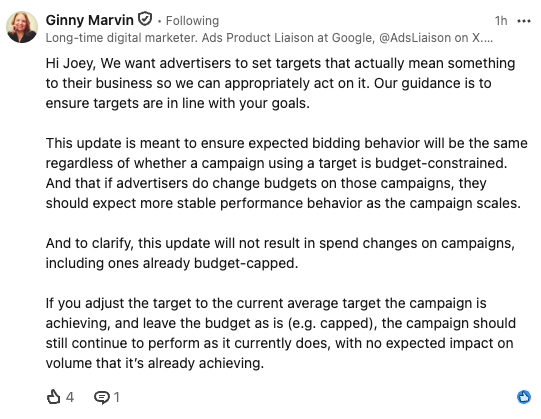
Source: LinkedIn
Your target stops being a soft suggestion and starts functioning as an instruction. If the number you set doesn’t match what the campaign is actually achieving, expect that gap to close, not necessarily more spend, but your CPA or ROAS drifting toward whatever target you entered – possibly a while ago and since forgotten.
Are There Any Potential Issues for Paid Search?
The reaction has been more substantive than a simple “Google wants more of my money” complaint. This is definitely something worth taking very seriously.
A recurring on LinkedIn that I’ve noticed while sleuthing, including from PPC practitioners including Kirk Williams and Jack Carr, is that a loose target has long been a deliberate lever – give Smart Bidding room between the stated target and actual performance, and it can explore more efficiently within a fixed budget.
Treating that gap as something to eliminate, rather than a legitimate optimisation tactic, is the crux of the frustration. Kristen Kelleher and others have also questioned whether pushing campaigns toward stated targets risks pulling in lower-quality traffic to hit the number.
Marvin’s response has focused on consistency rather than conceding the tactic: “Performance has often fluctuated unexpectedly… especially with budget changes. That’s not been a great experience for advertisers.”
On the quality question, she’s maintained the system will “find as many conversions as possible at the ROAS/CPA target you set.” Whether that fully answers the concern is, understandably, still being debated… As things stand, plenty of practitioners remain unconvinced and are waiting to see what the data shows after August 17th.
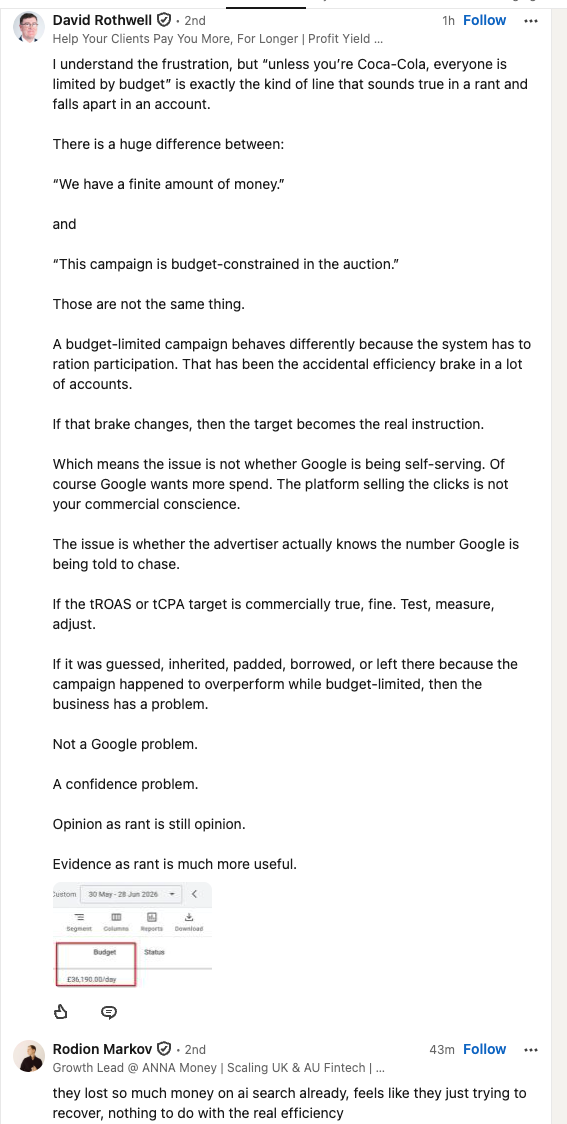
Source: LinkedIn
There’s also a trust dimension that’s hard to separate from the technical debate. Google has had a rocky few months on the ads integrity front, and some advertisers are reading this change through that lens, assuming the worst case interpretation (Google engineering a reason to increase spend) rather than the stated one (tightening consistency).
I’m treating that scepticism as reasonable context rather than confirmed motive. Google’s public statements are unambiguous that budgets aren’t increasing, but I understand why a wary advertiser would want to watch their own numbers rather than take that on faith.
Actions to Take for Paid Marketers
Anything that runs on Maximize Conversions, or Maximize Conversion Value with no cap, will have nothing happen to them because they were never in scope.
If you have a Shopping campaign on Target ROAS flagged as budget-constrained, currently running under its target rather than over it… We’d have to see what happens there. Since it’s underperforming the target rather than beating it, it’s genuinely unclear which direction this would push it after the 17th – watch any examples like this very closely.
Google has a Bid/Target Adjustment Tool for reviewing and resetting targets before the change lands, surfaced via an account notification or in the campaign’s bidding settings. I’d advise to check whether it’s visible in your account yet, since rollout has been staggered.
My final recommendation is to audit any Target CPA, Target ROAS or Demand Gen Target CPC campaign currently flagged as budget-limited before August 17, and make sure the target you set reflects where you actually want performance to land, not where it happened to settle a few months ago.
To help your brand stay ahead of the curve in the PPC landscape, reach out to the team at Iff Digital for a chat about how we can help your brand.
Key Resources
Changes To Target-Based Bid Strategies – Google Ads Help
Frequently Asked Questions About Changes To Target-Based Bid Strategies – Google Ads Help
Google Clarifies Smart Bidding Update After Advertiser Concerns – Search Engine Journal
Google Ads Video Q&A On August 17 Bidding Update – Search Engine Roundtable
Google Ads Updates Target-Based Bidding For Budget-Limited Campaigns – Search Engine Land